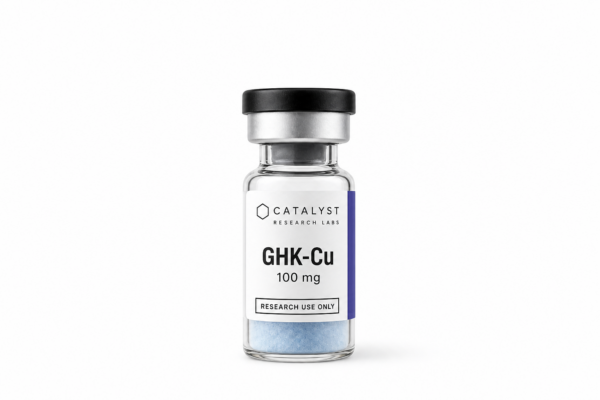
GHK-Cu
Copper tripeptide researched for tissue repair and skin health.
GHK-Cu
Background
GHK-Cu is a copper-binding tripeptide (glycyl-L-histidyl-L-lysine) complexed with copper(II), first isolated from human plasma. It has been studied for roles in tissue remodeling, collagen and glycosaminoglycan synthesis, antioxidant activity, and modulation of gene expression related to wound repair.
The copper peptide is well characterized in dermatological and wound-healing research and is widely used in cosmetic formulation, with a substantial in-vitro and animal literature.
Selected literature
- Pickart L, Margolina A. Regenerative and protective actions of the GHK-Cu peptide in the light of the new gene data. International Journal of Molecular Sciences. 2018;19(7):1987.
- Pickart L, Vasquez-Soltero JM, Margolina A. GHK peptide as a natural modulator of multiple cellular pathways in skin regeneration. BioMed Research International. 2015;2015:648108.
- Pickart L. The human tripeptide GHK and tissue remodeling. Journal of Biomaterials Science. 2008;19(8):969-988.
References are provided for scientific context only. Citation does not imply endorsement of any use, nor a claim of safety or efficacy. Findings frequently derive from in-vitro or animal models.
Trademarks & attribution
The GHK-Cu tripeptide was first described by Loren Pickart. It appears in cosmetic products under various proprietary names owned by their respective manufacturers; the compound itself is not trademark-restricted. Supplied as reference material only.