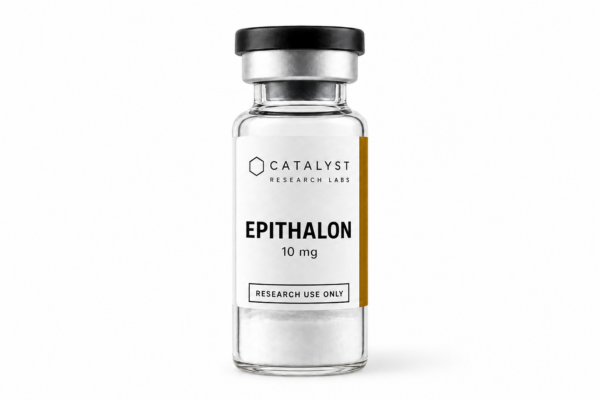
Epithalon
Tetrapeptide researched for telomerase activation and longevity.
Epithalon
Background
Epithalon (also written Epitalon; sequence Ala-Glu-Asp-Gly) is a synthetic tetrapeptide derived from the pineal polypeptide preparation epithalamin. It has been studied principally in the context of geroprotection, with proposed mechanisms including modulation of telomerase activity and circadian/neuroendocrine regulation.
Much of the published work originates from the St. Petersburg Institute of Bioregulation and Gerontology and includes cell-culture reports of telomerase induction and rodent longevity studies. Independent replication and human clinical data remain limited.
Selected literature
- Khavinson VKh, et al. Peptide promotes overcoming of the division limit (Hayflick limit) of human somatic cells. Bulletin of Experimental Biology and Medicine. 2003;135(6):590-592.
- Anisimov VN, Khavinson VKh. Peptide bioregulation of aging: results and prospects. Biogerontology. 2010;11(2):139-149.
- Korkushko OV, et al. Geroprotective effect of epithalamin and epithalon in elderly subjects. Bulletin of Experimental Biology and Medicine. 2006;142(4):415-418.
References are provided for scientific context only. Citation does not imply endorsement of any use, nor a claim of safety or efficacy. Findings frequently derive from in-vitro or animal models.
Trademarks & attribution
Epithalon (Epitalon) was developed at the St. Petersburg Institute of Bioregulation and Gerontology and has no registered Western pharmaceutical trademark or approved drug product. Catalyst Research Labs is not affiliated with that institute. Supplied as reference material only.